

What's Your Mission? On Stories, Art, and Shared Humanity
Why our stories matter now more than ever

I posted a note on Martin Luther King Jr. Day, sharing my mission and asking writers to name theirs.
My fifth grader had been reading about Dr. King that morning, and we talked about his dream, how his words moved people to action, and changed what people thought was possible. His mission was carried through stories: speeches that painted pictures and metaphors that shifted thinking.
Later, I wondered if my writing should be more serious. I mean, the world is a greasy dumpster fire, and my last post featured my adaptation to Ecuador as a lab report. How can I justify experimenting with literary styles when there are actual crises happening?

I suspect others feel the same way. It can feel gratuitous to write when everything is burning.
At a writing conference last year, a publisher said she looks for authors who are “part of the conversation.” That intimidated me because I assumed it must have some political intent or be radical. But now I see it’s simply about being part of a community: reading other people’s work, supporting them, engaging with their ideas, seeing how their stories connect to mine.
The Real Problem: Art Isn’t Considered Legitimate
But on a larger scale, art isn’t recognized as a legitimate form of dialogue. Stories aren’t seen as part of the conversation about what matters.
Often, artistic forms must have a political purpose to feel legitimate:
A novel about systemic racism = “important work”
A memoir about trauma = “necessary”
But creating something beautiful just because beauty matters= fluff
A story that reminds us what it feels like to be human= woo, woo
I believe that human creativity is the best defense against an increasingly disconnected world.
Art is healing.
Amie McNee writes in We Need Your Art: “You won’t just serve yourself when you create and share your art, you’ll serve the collective. Art heals and enhances communities. Your art will enhance and heal your community.”
Creating and sharing, whether or not they have an obvious political purpose, are participating in the conversation. It’s tending to our collective humanity and building the infrastructure we need to survive what’s coming.
So when I asked writers to name their missions, look what happened:
The Missions That Emerged
Laura B Writing in the Shadows said: “To let people find hope in the darkness and have them feel seen if they have gone through anything similar.” She told me later: “I could have used that when I was in it all.” She’s creating the thing she needed.
Marlana described her community as “not polished, not performative,” a space for witnessing life-quakes and rebirth while they’re still alive. She said, “More humans working towards lifting each other up is definitely a world I want to be a part of.” I personally benefited from her mission in so many ways.
The Punk Granny is deconstructing outdated ideas about aging, helping mid-lifers reclaim their power and chase their passions with fervor, and she’s just a kick-ass human.
Adrian Landin (With Gusto) wrote: “I’m fiercely committed to making a meaningful difference both within my own community and within the lives of the locals I befriend along the way.” He’s done everything from raising money for his friends abroad to being the anti-ugly American traveler.
Elias | Go Unpacked (Go Unpacked) helps people navigate travel not as an escape or a means of burnout management, but as a way to expand their world of geography, identity, and belief. He asks: How do you create journeys that don’t end with you back in the same cycle when you return? Elias shares his life abroad with us in real time, making us question what is possible.
Erin Pyper, MSW is exposing brutal societal truths about social problems with her social work and accountability mindset. She is pure mission mindset, and one of the most dedicated writers out there.
Moorea Maguire (Mirrors, Signals, Blindspots) is calling out the media’s inaccurate reporting on research. She writes: “All too often, journalists state, ‘the science tells us...’ and then go on to report exactly what the science doesn’t tell us.”
Shebeastspitn wrote: “To assure no one ever feels alone in the dark feelings I have ever experienced.”
Dr. Tara Cousineau 💛 is helping people love themselves and shine a light on their innate gifts.
Simla is turning the tide of autoimmune disease and easing the perimenopause transition for 10,000+ women over the next ten years. She said: “Because the world needs women, healthy and in our full power, more than ever.”
Isabella Skrypczak is bringing humanity back to an ever-polarized, divided world.
And my mission? Sharing stories and encouraging others to find and share their stories. By engaging with each other’s stories, we gain a deeper understanding of the universality of our experiences and form more profound human connections.
Not everyone reading this is a writer or has a newsletter. Some of you are readers, engagers, and sharers, and that’s essential too. The way you show up for people, the stories you tell at dinner tables or coffee shops, the perspective you offer a friend who’s struggling, your willingness to really listen and see things differently. That’s the conversation, too.
Stories Are Legitimate Dialogue
Every single one of these missions addresses something urgent: mental health and isolation, ageism and erasure, community fragmentation, healthcare inequity, polarization and dehumanization, and the need for hope and connection.
These are issues people face every day.
Can policy, politics, or activism raise awareness? Yes. But I think people have been desensitized to these methods. Maybe we’ve lost faith in their effectiveness because they remind us of the problem and how far away the solution is. We certainly need policy and activism, but stories do something different.

Stories are how we address these crises, not instead of policy or activism or journalism or medicine, but alongside them. As part of a systematic change.
Because stories do what other forms of dialogue can’t:
Make us feel what statistics can’t convey.
Help us see perspectives we’ve never considered.
Challenge us to recognize ourselves in an unfamiliar narrative
This is how consciousness shifts and how culture changes.
Whether it’s Substack, a blog, a newsletter, social media, or simply engaging with others’ stories. We’re not shouting into the void (even when it really feels like we are).
We’re building infrastructure for human connection.
Claim Your Work
My essays usually center on travel experiences, but I always highlight the universal truths I discover because I know people will relate. So my essays set in Ecuador or Bahrain are really about displacement, belonging, identity, the things we all grapple with, no matter where we live.
Your writing about aging, health, social work, or teaching might address a crisis that the “serious” discourse has ignored.
Your story is not a distraction. It is the actual work.
So claim it. Claim your work and your mission. Like it’s your job.
Because it is.
You are the only person in the world with your unique voice, particular perspective, and the specific experiences that led you here. Nobody else can tell your story or reach the people only you can reach.
What’s Your Mission?
I’ve worked in schools all my life, and at some point, teachers end up sitting in a room revising the school’s mission statement. It’s tedious work because it’s not alive inside us.
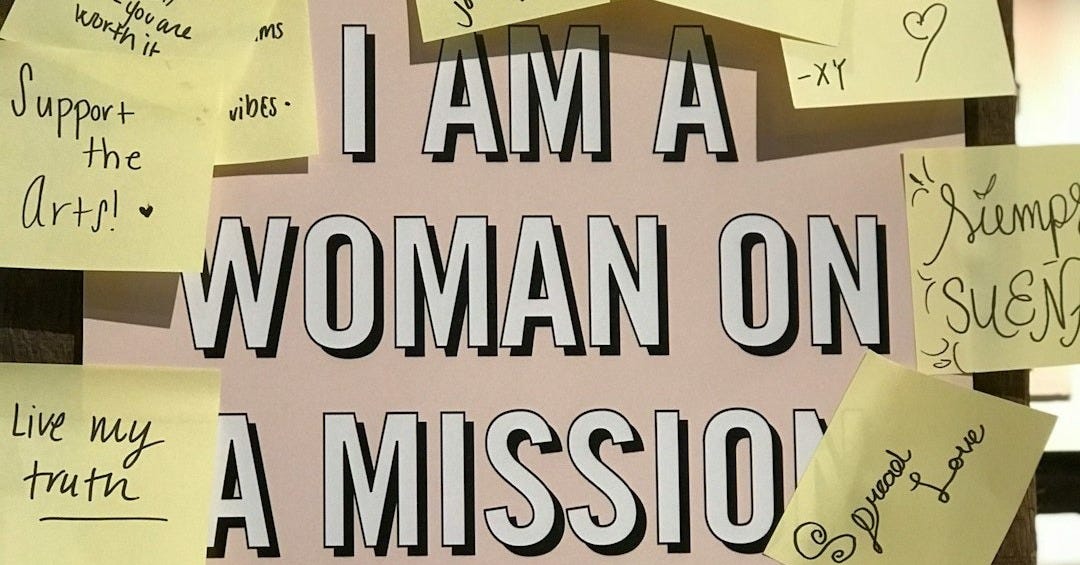
But teachers need a mission for their classrooms. Artists need a mission. It’s more than purpose. Maybe purpose is what you want to do, and mission is why it matters.
So I’m asking: What’s your mission?
Whether you’re a writer with a newsletter, someone who shares thoughts on social media, a commenter who engages with others’ work, or someone who carries stories to the people in your life, what are you here to do? Why does it matter?
Name it. In the comments, I would love to hear it and help you spread the word.
Your story, however you share it, isn’t gratuitous. It’s what we need to survive what’s coming and build what’s next.
Awesome post—and thanks for the curated list of writers. Honestly feel like the “Reads” tab on everyone’s profile could use a few custom sentences exactly like what you did here.
My mission is to start a movement, community, *something* around tech addiction and sobriety. So many of us are “addicted” to our phones and apps, but we’re stuck in this weird limbo where we talk about it in a half-joking way… while secretly feeling stuck, embarrassed, and wishing for a fresh perspective or even a new identity around it.
To use an analogy, it feels like we’re back in the 1960s—except the vice isn’t smoking, it’s tech. The ’60s were when evidence about the long-term (and short-term) impacts of smoking really started to emerge. And at the same time, society collectively realized it wasn’t as simple as “just stop.” It took decades for smoking rates to actually fall.
That’s the limbo I think we’re in right now with tech. And it feels about time it was addressed properly.
I loved how you weaved together our missions into the greater purpose of the common good. This was inspiring.
And thank you so much for the shout-out.